
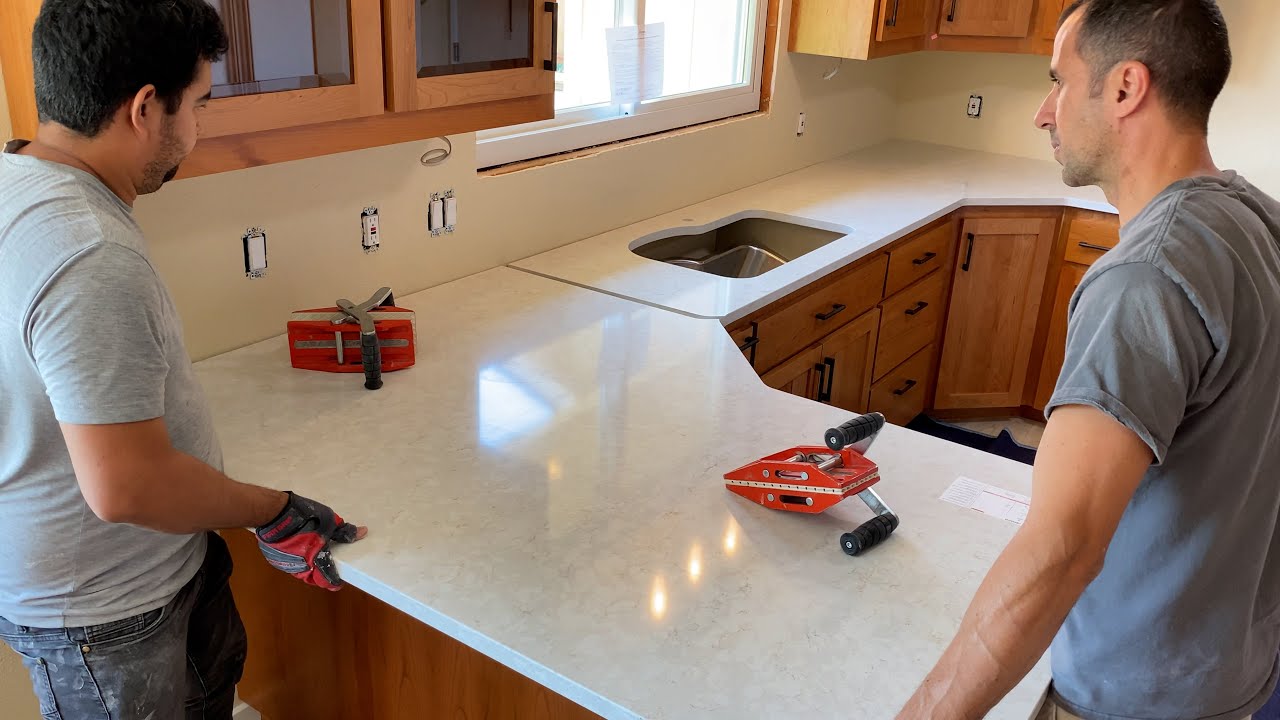
Ever wonder why some kitchen countertops look as beautiful after 15 years and others are scratched, stained and heat damaged after just six months of use? It all depended on the type of material used. Under actual kitchen conditions, marble, granite and quartz are three very different materials, and if you choose the wrong one, you’ll be looking at it every morning for $5,000 to $12,000. The majority of customers purchase according to looks only, and only find out about the failures after the day of fabrication. This guide provides information on aspects the showroom doesn’t tell you: acid sensitivity, heat tolerances, sealing schedules, UV degradation and long-term showroom restoration costs, so you can make an informed decision on which materials to use based on how they perform, not just how they look on a slab on display.
What Each Material Actually Is
Marble
Marble is metamorphic rock limestone transformed by extreme heat and pressure over millions of years. This generates the veining people adore, but also leaves behind calcium carbonate, which is the dominant mineral. Acids react with calcium carbonate which they come into contact with. Lemon juice, vinegar and tomato will leave chemical marks on the marble surface that are not possible to wipe away and will have to be professionally re-polished.
Granite
Granite is an igneous rock made of quartz, feldspar and mica. It is harder than marble, and does not etch by kitchen acids. Every slab is geologically unique, quarried from Brazil, India, Norway, and South Africa. It is porous and requires periodic sealing, but its mineral hardness and acid resistance make it far better suited to active kitchen environments than marble.
Quartz
Quartz is a man-made stone that is made up of 90 to 94 percent ground quartz crystals, polymer resins, and pigments. A non-porous and dimensionally stable surface is produced during the manufacturing process, that will not require sealing at any time. It is susceptible to heat and UV exposure for extended periods, however, which the resin part is not.
The Maintenance Reality
Marble
Marble should be sealed every 3–6 months, and sealing will only help with staining and not etching. There is no sealer available on the market which is capable to protect the marble from acid damage. In active kitchens, etching accumulates as a near certainty over time. Etched marks are much less noticeable with a honed finish than a polished one, which is why most of the practical use of marble in kitchens is a honed finish. In a working kitchen, the polished marble appearance will not last if you don’t want to re-polish from time to time.
Granite
Steps must be taken to seal granite every 12-18 months with a penetrating impregnator sealer, NOT a surface sealer. The more compact and darker granites, for example, will require less sealing than lighter, more porous granites such as White Ice and Colonial White. Other than that preprogrammed job, maintenance should be minimal. Granite is also resistant to etching, will withstand direct heat, and slabs installed in the 1990s are still in good working order today. After sealing, there is a low maintenance ceiling.
Quartz
Quartz will never need sealing. Turmeric, beet juice, red wine and coffee stains merely lay on top of the surface and do not seep through it. The most common method of cleanup is with a damp cloth. The only maintenance requirement quartz really has is the consistent use of a trivet near cook tops and ovens; this is a requirement as polymer resins will not stand up to heat contact of a higher temperature than 300°F over a period of time.
Heat and UV Tolerance
Where Granite Wins
Granite can not only withstand the heat of hot pots and pans, but also any other type of direct heat. A 450°F Dutch oven will not discolour, crack or be damaged whatsoever when it is taken off the burner and placed on granite. This becomes a daily functional benefit that quartz can’t rivals no matter what the brand or price is, for households that prioritize serious stove top cooking, braising, batch cooking and canning.
Where Quartz Has Real Limitations
Discoloration and microfractures are commonly reported from direct contact of hot pans on quartz surfaces by fabricators and stone restoration professionals. Polymer resins in quartz starts to break down at sustained heat temperatures of 300+°F. Trivets must be used, they are not optional. A second known drawback is that quartz near large, south-facing windows or skylights may turn yellow in as little as five to 10 years due to UV degradation. This is not a problem on either marble or granite because, natural stone is not damaged by UV rays.
Scratch and Impact Resistance
Granite falls somewhere in the middle at 6-7 on the Mohs hardness scale, meaning it is very resistant to scratching on the surface of the countertop from knives, ceramic cookware, and abrasive cleaning tools. Quartz engineered stone comes with the same measurement. The softest of the three, at 3-4 on the Mohs scale, Marble will develop noticeable surface scratches in any kitchen that is used on a daily basis. An aside: The blades of the knives will get dull much sooner than they would on a wooden or plastic cutting board, but installing granite or quartz will mean that the countertop surface is protected 100%.
Hygiene Considerations
Quartz is also non-porous, which means that there aren’t tiny openings between individual crystals that bacteria can settle into—an important point to keep in mind if you’re preparing raw poultry or fish on your kitchen counter. Granite and marble, as porous natural stones, rely on consistent sealing to minimize bacterial penetration. That protection is as secure as the sealing schedule that is applied behind them. A house that regularly cooks raw proteins will have an under-sealed granite or marble surface that quartz has by material alone.
Longevity and Restoration
While all three materials will last longer than the majority of kitchens in which they are installed, they age in various ways. The main thing to note about quartz is that it resists change very well for the first 10 to 15 years and then UV exopsure areas and heat damaged areas may need to be section replaced as quartz cannot be re-polished or re-done like natural stone can. Granite and marble, on the other hand, can be honed, re-polished and re-sealed as many times as desired by a professional. After 20 years, a granite counter that looks worn down can be taken care of to near its original condition without having to replace it a factor that is often overlooked in the typical countertop comparisons but has a significant impact on lifetime value.
Matching Material to Your Kitchen
Choose Marble If
You have a kitchen that is used more moderately or a marble for a less used area such as a pastry station, bathroom vanity or fireplace surround. When one understands etching and does not consider it a fault in the product, but rather something inherent in the material, and appearance is the primary consideration, then marble is the only material that will provide the visual results that granite and quartz can’t provide, no matter what the price is.
Choose Granite If
You are heavy handed in the kitchen, cooktop heavy and you don’t want a natural stone surface that is sensitive to acids like marble. Granite is a good option for homeowners who are able to seal it every year, and who desire that geological uniqueness without the fragility that marble brings to a working environment in the kitchen.
Choose Quartz If
Your kitchen is used a lot, you have young kids, a lot of entertaining, or foods that stain frequently, such as turmeric and berries. A quartz surface also has practical reasons; they are great in a rental home or second house where sealing cannot be relied upon and maintenance cannot be guaranteed.
Cost Comparison in 2026
Adjustments to import tariffs have caused changes in the prices of all three materials this year for stone from Brazil and for stone from India. Today Marble prices between $75 and $160 per square foot installed, with Calacatta Gold and Statuario being at the high end of that. Granite ranges from $55 to $130 per square foot installed, and some exotic Scandinavian and African granites are at the high end. Quartz cost $70 to $150 per square foot installed, with Cambria and Silestone available for higher prices due to the proprietary colorways and warranties offered. In the mid-grade, all three materials fall into almost the same price range which makes it impossible to decide on price alone.
Conclusion
The right countertop is not the most expensive one or the most visually striking one in the showroom it is the one that matches how your kitchen actually functions day to day. Marble is the fruit of patience and careful use and in return provides unequalled visual elegance. Granite is great for cooks with a tolerance for heat and looking for authentic earth appeal that isn’t compromised by marble’s acid reaction. Quartz rewards households that prioritize zero-maintenance performance and stain resistance above everything else. If this match is right, any of these surfaces will perform problem-free for twenty years or more.
JJ Marble & Granite provides the material knowledge and craftsmanship to ensure your countertop will do exactly what you want, from the first day you install it until decades down the road when you use it.