
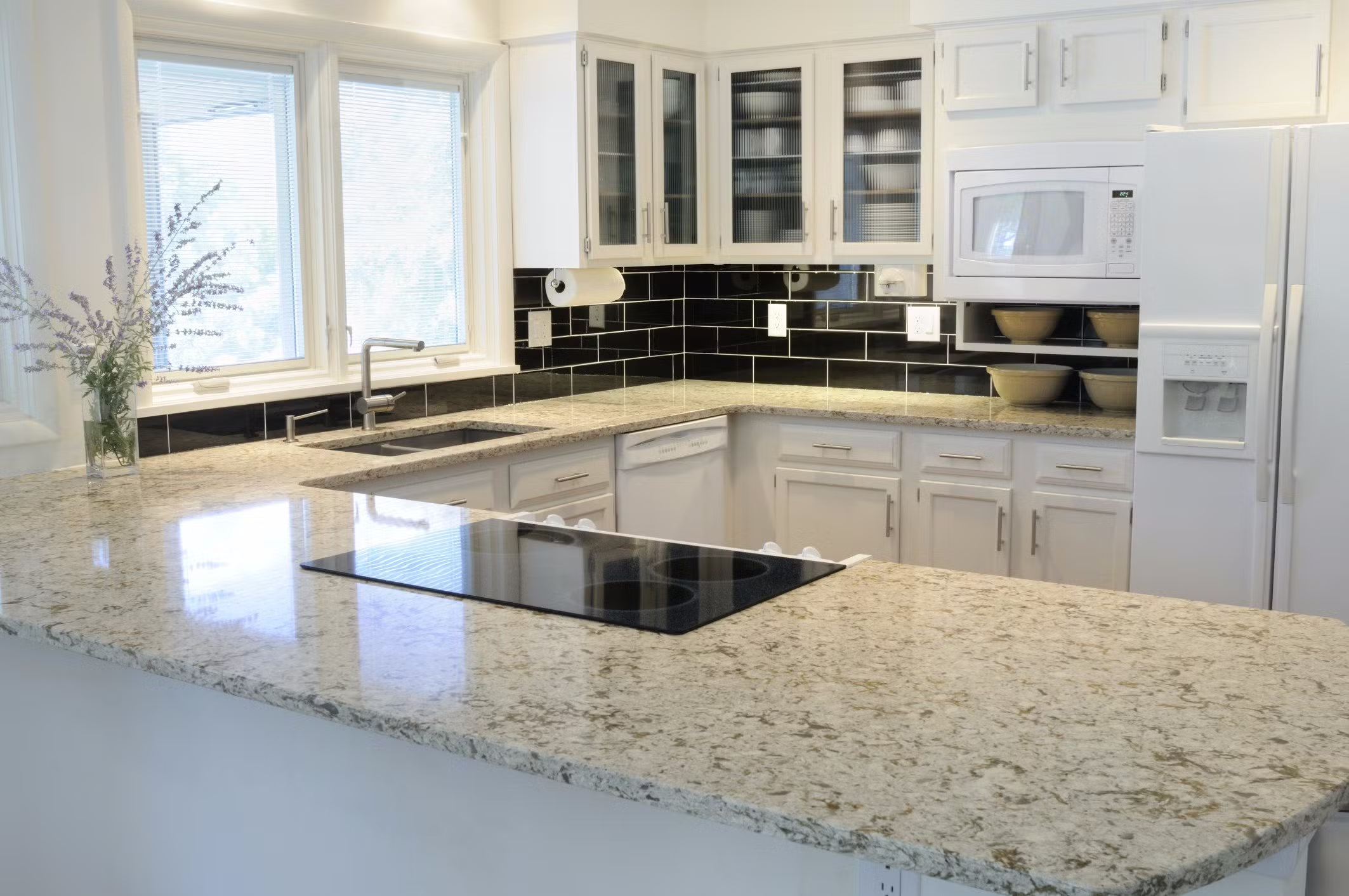
You’ve probably Googled “quartz vs granite countertops” and landed on the same recycled breakdown a dozen times. Quartz is low-maintenance. Granite is natural. Both are durable. You already know this. The part you don’t know is which one makes it through your kitchen, the Sunday meal preps, the hot pans, the turmeric spills, the kids. When it comes to selecting a surface in 2026, with prices becoming more aligned and new quartz formulations becoming available, one simply cannot afford to make the wrong choice because it will haunt them every morning for several years and cost $4,000 to $8,000. This guide does not skimp on the filler, and provides you with the substance differences that count before committing to a fabrication order.
What Quartz Countertops Are Actually Made Of
Quartz countertops are a man-made stone product that is approximately 90 to 95% ground quartz crystals and bound with polymer resins and pigments. It is this manufacturing process that allows quartz to be so consistent throughout a complete slab: the color, veining and pattern are not things that are going to be dictated by geology, they’re going to be set at the factory level.
Quartz is made with resin binders that make it non-porous. No tiny holes for bacteria, wine or coffee to seep in. Quartz doesn’t seal not when it is installed, not ever. A significant maintenance advantage over granite which requires regular sealing.
But the same resins are not heat-resistant. A cast iron skillet that is hot and set directly on a quartz surface could cause discoloring or microcracks in the resin surface if it is placed directly on the surface at 400°F. With quartz, trivets aren’t merely a luxury, they’re a necessity.
What Granite Countertops Are Actually Made Of
Granite rocks are igneous rocks that form when magma cools slowly and the resulting rock is made up of mainly quartz, feldspar and mica. No two slabs are alike from a quarry in Brazil, India, Norway or Italy, after the crystal like structure, color variation and movement in the stone are not repeatable. That is part of the granite buyer’s “individuality”.
The Mohs scale of hardness puts granite at 6-7, versus 7 or so for quartz engineered stone, but the natural porosity of granite is not favorable for a kitchen environment. Granite will absorb oils, liquids with acid, and staining compounds over time unless sealed annually with a penetrating impregnator sealer. Red wine left sitting on unsealed granite overnight is not a hypothetical; it is a documented problem that restoration specialists deal with regularly.
The good news is that it’s heat resistant. Granite can come in direct contact with hot pots and pans without suffering structural consequences. For cooks who move between stovetop and prep surface constantly, this is a real practical advantage.
Head-to-Head: Where Each Material Actually Wins
Quartz Advantages in a Working Kitchen
- Stain resistance without maintenance: Because quartz is non-porous, spills from tomato sauce, turmeric, beet juice, and red wine sit on the surface rather than penetrating it. A damp cloth handles cleanup in most cases.
- Consistent appearance across the entire countertop run: In kitchens with large islands or L-shaped layouts, matching adjacent slabs is far easier with engineered quartz than with natural stone.
- Antibacterial surface behavior: The non-porous composition means there is no substrate for bacteria to colonize between the surface crystals a relevant consideration for households that prep raw proteins directly on the countertop.
- Impact uniformity: Because the material composition is consistent throughout the slab, chips and edge damage are less visually jarring than on granite, where a chip can expose a dramatically different interior color.
Granite Advantages in a Working Kitchen
- Direct heat contact without damage: Pulling a Dutch oven off the burner and setting it on granite does not require a trivet or a moment of hesitation.
- True uniqueness in appearance: The veining, mineral inclusions, and color gradations in granite cannot be manufactured. If the visual goal is a countertop that reads as genuinely natural, granite achieves that in a way engineered stone cannot fully replicate.
- Scratch resistance at the surface level: Granite’s feldspar-and-quartz mineral composition makes it highly resistant to scratching from knives and abrasive materials though cutting directly on granite will dull your knife blades over time.
- Long-term value perception: In resale contexts, natural stone countertops continue to carry a value signal that engineered products do not always match, particularly in luxury residential markets.
The Cost Reality in 2026
In 2026, the cost of the two materials has changed with the tariff changes in the imported stone from Brazil and India. The price range for granite is now from $55 to $130 per square foot installed, with the rarest and thickest slabs on the end of the range. The price range of quartz ranges from $70 to $150 per square foot installed, and brands like Silestone, Caesarstone and Cambria offer a premium price for their proprietary colorways and longer warranties.
The cost crossover point is real: mid-grade quartz and mid-grade granite now occupy nearly the same price band. What separates them at that tier is not cost it is performance priorities and aesthetic preferences.
Fabrication costs are not material dependent, but are caused by edge profiles, cut-outs for undermount sinks and cook-top openings. No matter what surface you’re looking at, those will add up to a significant part of the project cost for a kitchen with a large island, apron-front sink cutout and waterfall edge treatment.
Which Kitchens Are Actually Better Suited to Each Material
Quartz is practical when: The family has young children, entertains often, or cooks who regularly use highly pigmented foods beets, berries, curry. It also is sensible in rental properties or second homes where annual sealing up will not be done consistently.
Granite is best for: When the kitchen is used extensively for stovetop cooking and moving around hot cookware. It is also an ideal choice for homeowners seeking the aesthetic appeal that natural stone brings to their home, and willing to make sealing a part of their maintenance plan. Sealed granite also performs well in kitchens of dry climates where there is less humidity.
The Durability Question Over 20 Years
With some basic maintenance, both materials will outlast most kitchens in which they are used. The toughness comparison is not simply who has less cracking or chipping, but what type of wear a given material will have after 20 years.
While quartz is virtually maintenance-free, it can develop a slight yellowing along the edges of the unit near windows where it gets the most exposure to the UV from the polymer resin that holds the quartz together. Properly sealed on a 12-18 month schedule, granite is highly resistant to staining and will not deteriorate as a result of exposure to UV. The trade-off is that maintenance consistency becomes a variable a homeowner who forgets to reseal for three years will see the effects in the stone.
Conclusion
There’s no correct or incorrect choice – it simply depends on the way your kitchen works, not on the way you wish it would work: neither quartz nor granite is universally superior. Quartz is the most resistant and is an easy-to-maintain material if that is the goal. If heat tolerance, natural stone character, and resale perception matter more, granite earns its place.
JJ Marble & Granite brings not only the craftsmanship needed for the job, but also product knowledge to ensure that the surface you select is exactly what you want and will function as expected for up to twenty years, for homeowners who seek professional fabrication and installation, precise edgework, material sourcing expertise and slab selection guidance.